Jul 6
/
Michelle Bramley-Brookes
Blog Two: Behaviour and Challenging Behaviour in Schools Today
Understanding Behaviour as Communication
Every suspension tells a story, but schools often have to act before they fully understand it. Behaviour is increasingly understood as communication shaped by development, regulation, unmet need, relationships and context. Yet language alone changes little: unless schools identify what sits beneath behaviour and respond consistently, children can still lose learning, connection and trust.
SEMH and the Wider Context of Need
This matters particularly for social, emotional and mental health needs. SEMH is a recognised area of SEND, and anxiety, trauma, sensory overload, communication difficulty or repeated failure can present as refusal, disruption, aggression, withdrawal or dysregulation. Since the pandemic, many schools have seen greater emotional vulnerability alongside limited capacity and support.
National Suspension and Exclusion Trends
Department for Education data shows the scale of the issue. In autumn 2024/25 there were 335,671 suspensions and 3,715 permanent exclusions in England. Although lower than autumn 2023/24, suspensions remained far above pre-pandemic levels, at 4.02 per 100 pupils compared with 2.17 in autumn 2019/20. Persistent disruptive behaviour remained the most common recorded reason.
What Data Suggests
Local and organisational figures suggest similar pressures. Year 2024/25 data shows 8,451 suspensions in autumn and 6,854 in spring, with exclusions rising from 46 to 63. Rather than simply signalling worsening conduct, this may point to rising need, pressure on mainstream provision, assessment delays and insufficient early intervention.
The Tension for School Leaders and Staff
School leaders therefore face a difficult balance: understanding behaviour in context while maintaining safety, predictability and learning. Policies may reference restorative practice, trauma awareness or relational approaches, but these principles need consistent implementation. DfE behaviour advice and EEF guidance both stress whole-school consistency, relationships and attention to SEND; without capacity and specialist support, practice can become reactive.
Moving Beyond Behaviour as a Fixed Trait
Challenging behaviour should not be treated as a fixed trait. It often emerges from the interaction between environment, expectation, stress and support. Clear boundaries still matter, but they must sit alongside curiosity, regulation support, relational consistency and timely intervention, especially for pupils with SEMH needs, neurodivergence, speech and language difficulties, trauma or insecure attachment.
Aligning Behaviour, SEND and Exclusion Policies
A key structural problem is that behaviour, SEND and exclusion policies do not always operate as one framework. A pupil may be identified as needing reasonable adjustment or graduated support yet sanctioned through a separate process that gives too little weight to unmet need. This risks disciplining behaviours that should prompt assessment, adaptation or earlier intervention.
What Needs to Change
Schools need connected behaviour, SEND and suspension policies built around inclusion, reasonable adjustment, early identification and relational practice. The DfE’s July 2026 statutory guidance, Suspension and permanent exclusion from maintained schools, academies and pupil referral units in England, including pupil movement, reinforces this. It keeps suspension and permanent exclusion as lawful tools, with permanent exclusion as a last resort, but strengthens expectations around pupil movement, off-site direction, managed moves, safeguarding-related separation and governing board scrutiny.
For pupils with SEND or SEMH needs, exclusion decisions must link to the graduated response, reasonable adjustments, pupil voice, family engagement and evidence of support tried. Any move away from the usual setting should be transparent, reviewed and purposeful, not a drift away from mainstream accountability. Staff development should focus on regulation, de-escalation, adaptive teaching, neurodiversity, trauma-informed practice and lawful decision-making.
Key Differences Between the 2024 and 2026 Suspension and Exclusion Guidance
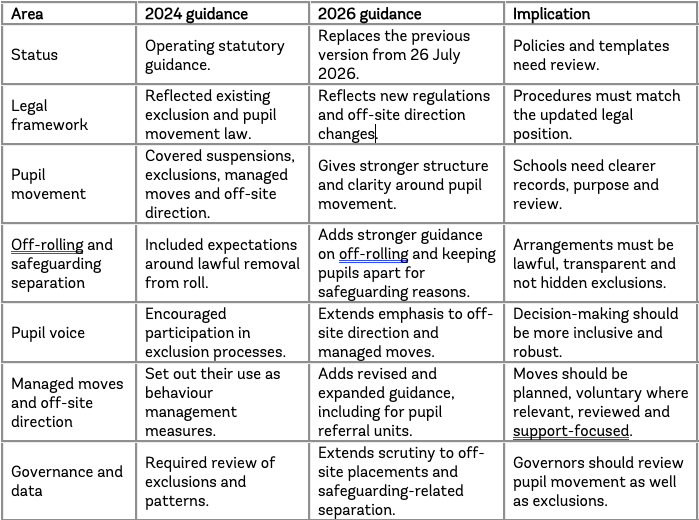
Overall, the 2026 guidance keeps the core exclusion principles but makes pupil movement more visible and accountable. Schools must ensure that off-site direction, managed moves, off-rolling and safeguarding-related separation are planned, reviewed and clearly linked to support.
Conclusion: Responding Before Crisis Point
The central question is not simply whether behaviour is getting worse, but whether systems respond to need before crisis point. Suspensions and exclusions remain high, often affecting pupils already experiencing disadvantage, unmet SEND, mental health difficulty or fragile engagement. If behaviour is communication, schools need systems that listen earlier, adapt more effectively and build relational safety before exclusion becomes the response.
References
Department for Education (2024) Behaviour in schools: advice for headteachers and school staff. Updated February 2024.
Department for Education (2024) School suspensions and permanent exclusions. Updated August 2024.
Department for Education (2026) Suspension and permanent exclusion from maintained schools, academies and pupil referral units in England, including pupil movement. Statutory guidance for maintained schools, academies and pupil referral units in England. July 2026; comes into force from 26 July 2026.
Department for Education (2023) SEND and alternative provision improvement plan: right support, right place, right time.
Education Endowment Foundation (2019) Improving Behaviour in Schools.
Department for Education (2023) Mental health issues affecting a pupil’s attendance: guidance for schools.
House of Commons Education Committee (2025) Solving the SEND Crisis.
National Education Union (2024) Trauma-informed practice and approach. Updated 2024.
Featured links
Connect with us
Copyright © 2026