School Exclusion Reform: What SEND Families and Schools Need
Key Takeaways
The proposals are at an evidence-gathering stage. They do not change exclusion law or statutory guidance, so schools must continue to follow their current duties while the government reviews responses.
A meaningful return is more than putting a pupil back on the same timetable. It should identify barriers such as unmet special educational needs, safety concerns, gaps in support, or a breakdown in relationships, then set out who will address each one.
The government is gathering evidence, not changing the current exclusion rules
Reintegration needs clear support, safety planning and regular review
Understanding unmet need helps staff plan safely and act accountably
Recognising unmet need does not excuse harmful behaviour or remove appropriate consequences
If you do one thing, make reintegration planning specific. A named staff lead, a check-in schedule, agreed adjustments and a review date make it easier to protect the pupil, staff and classmates.
If nothing changes around the pupil, what can a different return achieve?
A pupil may return from suspension to the same crowded corridor, unpredictable noise, anxious relationships, communication barriers, or learning needs that were not recognised the first time. If those conditions stay the same, a return meeting alone is unlikely to prevent another incident.
Around one in six pupils in England has identified special educational needs and disabilities. This makes accessible reintegration planning a practical need for many schools, not an optional extra.
So, start with the barriers around the pupil before setting expectations for their return. A pastoral lead might agree a quiet arrival time, while a teacher shares a one-page visual timetable, and a SENCO checks whether work has been adapted to the pupil's current reading, processing, or communication needs.
Make a short return plan with named adults, clear adjustments, and a review date within the first week. A plan works best when staff can follow it during a busy day. It fails when it lists vague promises such as “offer support” without saying who will do what and when.
What a safer return plan should address
Separate what may change from what still needs action. Proposals may shape future rules, but schools still need to identify risks, hear the pupil and family, and make reasonable adjustments where needed.
Ask the pupil what happened before the incident, including noise, conflict, task difficulty, or unclear instructions
Agree one or two immediate changes, such as a calm base at break or a check-in at the start of each lesson
Tell all relevant staff what to do, using plain and specific wording
Set a review after three to five school days and change the plan if it is not working
Record the pupil's view, the family's view, and any support that could not be put in place
A common mistake is treating reintegration as a conversation held once at the gate. The fix is to treat it as a monitored return: check attendance, lesson exits, peer conflict, and staff observations, then respond before concerns lead to another exclusion.
What the proposed reforms mean and what schools must still follow now
A parent may hear that exclusion rules are changing and assume a new right already applies. But a call for evidence is a request for experiences, data and views. It can shape later decisions, but it does not change what a school must do today.
Legislation is a law passed through the formal process. Statutory guidance is official guidance that schools and local authorities must take into account when making decisions. Until either changes, schools must follow the current exclusion procedure, including giving clear reasons, recording decisions and allowing families to challenge them.
What the three proposals could change
Next, the proposals point to three areas where practice may change. They are ideas under consideration, not current requirements.
Internal suspension limits: setting clearer boundaries on time spent out of normal lessons or away from peers
Reintegration partnerships: bringing schools, families, local services and relevant professionals together before and after a return
Learning during exclusion: making sure a pupil receives suitable education while they are excluded, rather than losing weeks of teaching
Ask the school what is happening now: where the pupil is learning, what work they are receiving, when the arrangement will be reviewed, and what support is planned for return.
Current duties still apply while proposals are considered
A proposal does not pause existing duties. Schools must still follow current exclusion procedures, consider the individual facts, and make decisions that are fair and recorded. A short internal removal may help after an immediate safety incident, but it can fail when it becomes a repeated, unreviewed placement with no clear teaching plan.
Schools must also meet their duties under the Equality Act. A reasonable adjustment is a practical change that reduces a disabled pupil's disadvantage, such as a calmer arrival, a movement break, visual instructions, or a planned check-in with a trusted adult. A common mistake is treating repeated behaviour as proof that support has failed - the better response is to review triggers, adjustments, and the return plan with the pupil and family.
How can internal suspension protect safety without becoming invisible exclusion?
Internal suspension can give staff and pupils a short period to lower risk after a serious incident, without removing a pupil from the school roll. It is different from formal suspension, where a pupil is officially excluded for a set period, and permanent exclusion, where the pupil is removed from the school.
The key question is whether the arrangement is brief, purposeful and reviewed. A pupil who spends several days each week in a separate room, with little teaching or contact with classmates, may be absent from school life even when they are marked present.
Warning signs that a short safety measure is becoming exclusion
Leaders should look for patterns rather than judging one incident alone. Internal suspension works best when it creates time to assess risk, repair relationships and plan a supported return. It fails when separation becomes the default response to distress, unmet need or repeated behaviour concerns.
Warning signs include:
The same pupil is sent out of class repeatedly over several weeks
The arrangement has no stated end date or review point
The pupil is placed in a corridor, office or other space that is not suitable for learning
Work is missing, inaccessible or not checked by a teacher
Reasonable adjustments for SEND are paused instead of reviewed
Families receive little information about why the arrangement is being used or what happens next
Safeguards that keep safety linked to learning and belonging
So, if a school uses internal suspension, it should record a clear reason, identify the immediate safety concern and set a time limit from the start. For example, a one-day separation after a fight may allow staff to speak with both pupils, check supervision plans and agree a supported return. It should not become an open-ended placement because a pupil is considered difficult to teach.
Review every repeat use. A pastoral lead, SENDCO and relevant teacher/s can check whether work was provided, adjustments were followed, and the pupil returned to lessons with a practical plan. For a pupil with sensory overload, that plan might include a quieter entry to class, a named adult at break and a five-minute check-in before science, rather than another day outside the classroom.
Video:
What must change for reintegration to work for pupils, staff and classmates?
So, a return plan should change the conditions that led to exclusion, not simply set a date for a pupil to come back. Before the first day, staff should check likely triggers, unmet needs, relationship breakdowns, bullying concerns, anxiety, sensory demands, and whether earlier agreed adjustments were actually provided.
Name one adult who owns the plan and who should check that each adjustment happens. A plan can fail when it lists support such as movement breaks or visual instructions but no one is responsible for putting it in place during a busy school day.
Turn concerns into shared actions
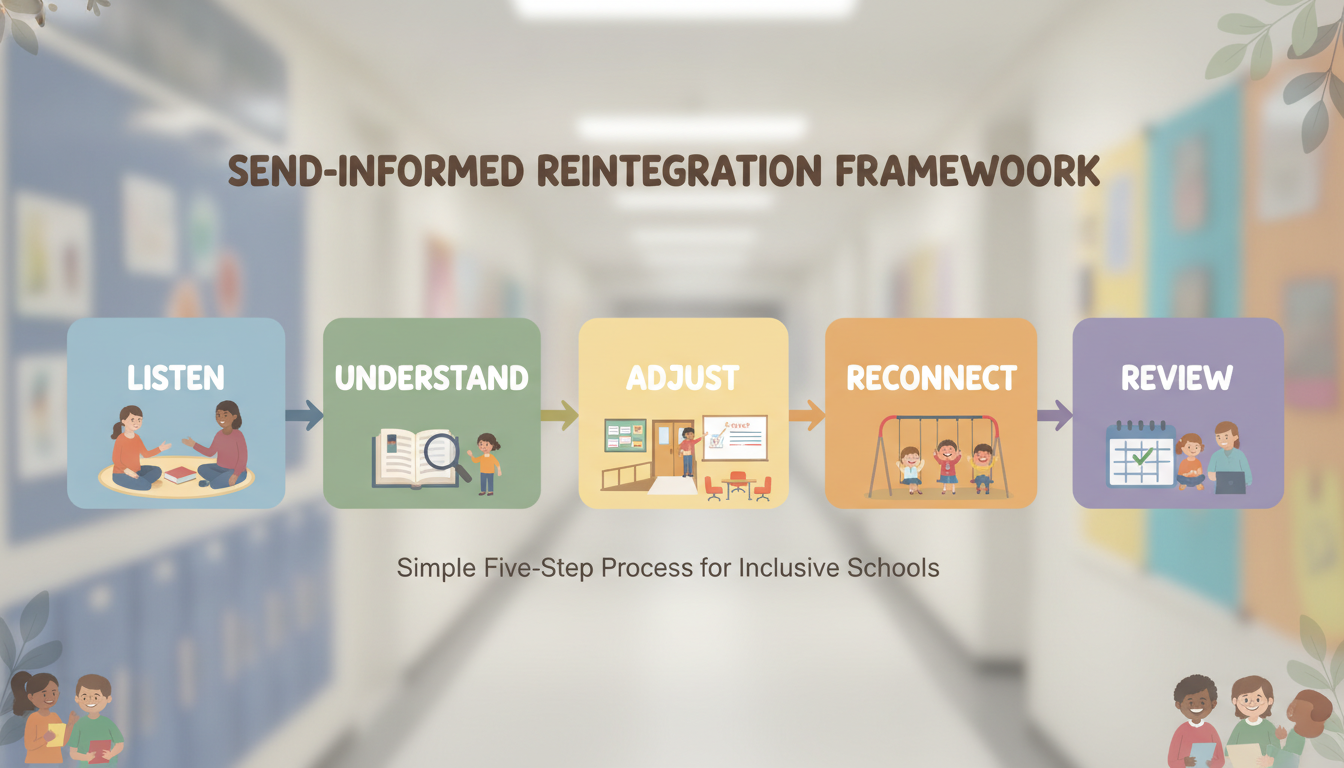
Next, use Listen, Understand, Adjust, Reconnect and Review to give the pupil, family and staff a clear sequence. Listen means hearing the pupil's account in a calm meeting; Understand means matching patterns, such as a spike in incidents after noisy lunch or in one lesson, with the support they need.
Listen: ask what felt unsafe, difficult or unfair, and record the pupil's words
Understand: check incident notes, attendance patterns, bullying reports and family information
Adjust: agree practical changes, an owner and a start date for every adjustment
Reconnect: plan safe contact with classmates, key adults and difficult parts of the timetable
Review: meet after the first day, first week and first month to check what is working
Make adjustments visible in the school day
In practice, small changes can prevent a familiar trigger from returning on day one. A pupil who becomes distressed in crowded corridors may leave class three minutes early with a trusted adult, while a pupil who struggles to process verbal directions may receive a one-page visual checklist before each lesson.
Supported returns work best when the pupil practises the hardest part of the day, rather than avoiding it without a plan. For example, a teaching assistant can meet a pupil at the door of science for the first two lessons, offer a planned regulation break, then reduce support once the routine feels safe. If staff capacity is short, prioritise the transition, the most difficult lesson and a daily check-in over a long list of support that cannot be delivered reliably.
What needs to change before a pupil returns?
A successful reintegration is not simply a child returning through the school gate. It means returning to a setting where safety, belonging and participation have a real chance of succeeding for the pupil, staff and classmates.
So, before the return date, school leaders should ask what will be different this time. If one thing is prioritised, it should be a clear, shared plan that names the pupil’s needs, the adults responsible and what staff will do when pressure builds.
In practice, a useful return plan checks whether the pupil has a trusted adult, a calm place to go, predictable times for learning and breaks, and a way to repair relationships after conflict. It should also set short review points, such as after the first week and first month, so the plan can change when evidence shows it is not working.
A return can fail when the pupil is expected to cope with the same triggers, unclear expectations and damaged relationships that led to exclusion. A better question is not whether the pupil is ready to return, but whether the school has made the changes needed for them to take part safely.
Share evidence that can strengthen future safeguards
Families and professionals can help make future safeguards more specific by recording what happened before, during and after exclusion or a difficult return. Broad concerns are easy to dismiss, but a dated example can show where support was missing, which adjustment was refused, or what helped a pupil attend safely.
If you submit evidence, focus on clear details rather than labels. For example, note that a pupil was sent home for three afternoons without work provided, that a sensory break reduced incidents from daily to once a week, or that a planned check-in with a trusted adult helped them remain in class.
Useful evidence can include:
Barriers such as unmet communication, sensory, mental health or transport needs
Missing support, including delayed plans, unavailable staff or no work during time away from school
Interventions that helped, such as a reduced timetable with review dates, a calm space or consistent pastoral contact
Protections that would have made the return safer for the pupil, staff and classmates
Keep a short timeline with dates, who was involved, what was agreed and what happened next. This can help families, schools and local services spot repeated gaps rather than treating each incident as separate.
Build a shared approach to reintegration and adjustments
Evidence should lead to practical changes, not only a record of harm. Sunshine Academy SEND training can help families and school staff build shared ways of planning reintegration, reviewing reasonable adjustments and responding early when a pupil begins to struggle.
Training works best when the adults around the pupil agree on a few actions they can carry out consistently. A long plan can fail when staff do not know their role, but three clear steps, such as a morning check-in, access to a quiet space and a weekly review, are easier to maintain.