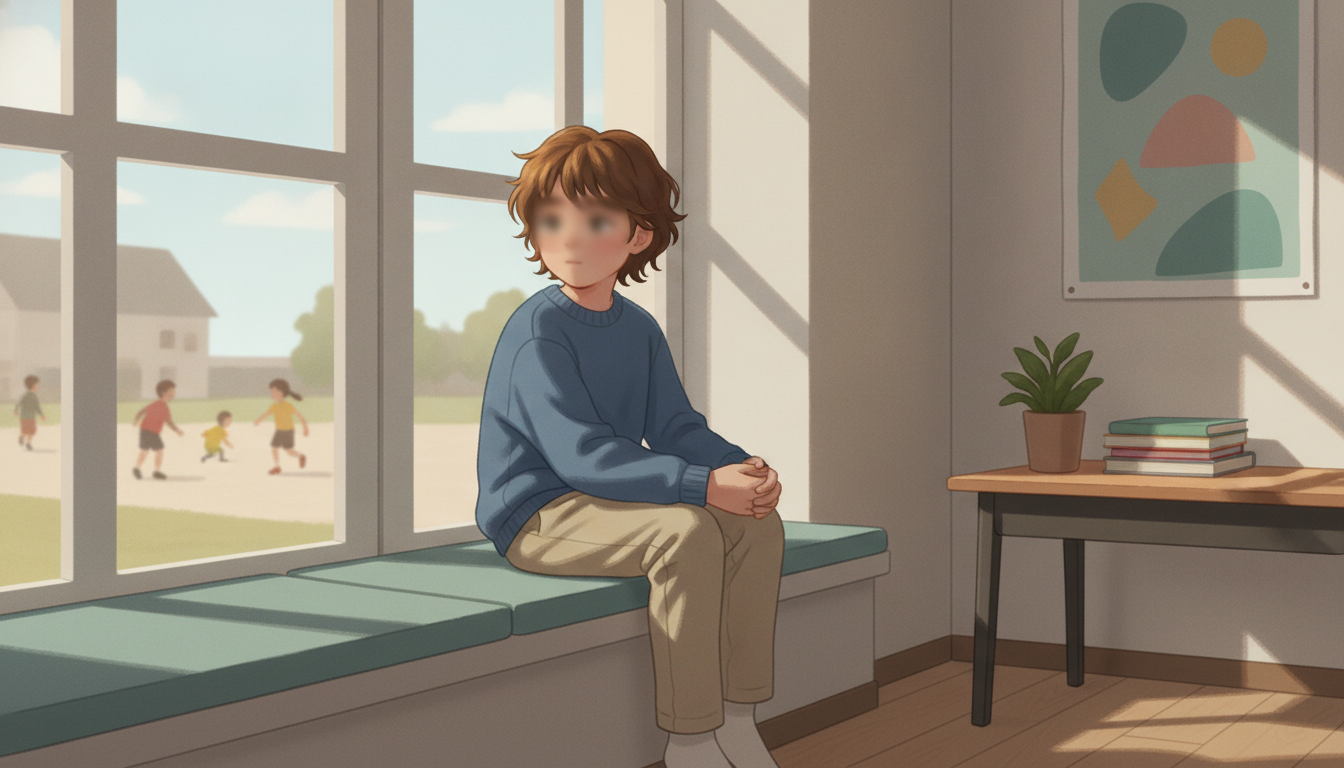
Trauma Changes More Than Behaviour: Looking Beyond What We See
When we hear the word trauma, many of us picture a single, life-changing event.
A serious accident.
A natural disaster.
A violent incident.
Whilst these experiences can absolutely be traumatic, trauma is often far more complex than many people realise. For some children, trauma develops gradually. It can result from ongoing experiences of fear, unpredictability, loss, bullying, neglect, abuse, medical procedures, domestic conflict, or living in an environment where they rarely feel safe.
Trauma is not defined by the event itself.
It is defined by how the experience affects the child.
Two children can experience the same situation and respond very differently. One may recover with the right support, while another may carry the effects for years. That's why understanding trauma is so important. It reminds us that every child has their own story, and every child deserves to be understood within the context of that story.
What Does Trauma Actually Do?
Trauma doesn't simply affect emotions.
It changes the way the brain and nervous system respond to the world.
When a child experiences overwhelming stress, their brain becomes focused on one thing above all else:
Survival.
The parts of the brain responsible for thinking, learning, planning and problem-solving become much harder to access because the brain is prioritising keeping the child safe.
This means a child may appear:
distracted
impulsive
withdrawn
angry
anxious
unable to concentrate
emotionally reactive
Not because they are choosing to behave this way.
But because their brain is responding to perceived danger.
As psychiatrist Bruce Perry has often explained, we cannot expect children to learn effectively when their brains are focused on survival rather than safety. Before children can fully engage with education, relationships or new experiences, they first need to feel safe enough to access the parts of the brain responsible for learning.
Behaviour Is Often the Last Chapter, Not the First
One of the biggest misconceptions about trauma is that it is always obvious.
It isn't.
Some children become loud.
Others become quiet.
Some appear constantly busy.
Others withdraw completely.
Some become perfectionists.
Others seem to stop trying altogether.
The behaviour we see is often the final chapter in a much longer story.
When adults focus only on the behaviour, it becomes easy to ask:
"Why are they behaving like this?"
A more helpful question is often:
"What might have happened that has led them to feel this way?"
That simple shift moves us away from judgement and towards understanding.
It doesn't excuse harmful behaviour.
But it does help explain where it may be coming from.
Trauma Can Look Different in Every Child
One of the challenges with trauma is that there is no single presentation.
For one child it may look like aggression.
For another, anxiety.
For another, complete emotional shutdown.
Some children become hypervigilant, constantly scanning their surroundings for potential danger.
Others appear detached, disconnected or emotionally numb.
Some become people-pleasers because keeping everyone happy feels safer than risking conflict.
Others struggle to trust adults at all.
The important point is this:
Trauma is not a behaviour.
It is an experience that can shape behaviour.
When we recognise this distinction, our responses begin to change.
Why Relationships Matter So Much
Research consistently tells us that healing does not happen because somebody says the right thing once.
Healing happens through relationships.
Children who have experienced trauma benefit from adults who are predictable, calm, compassionate and emotionally available.
That doesn't mean removing boundaries.
Children still need boundaries.
But those boundaries are most effective when they are built upon trust rather than fear.
Clinical psychologist Karen Treisman often talks about the importance of becoming "relationship detectives" rather than "behaviour detectives."
Instead of asking:
"How do I stop this behaviour?"
we begin asking:
"What is this child trying to communicate?"
That shift changes everything.
Trauma and Learning
Children cannot learn effectively when they are in survival mode.
Education relies on:
curiosity
memory
concentration
problem-solving
relationships
emotional regulation
All of these become significantly more difficult when a child's nervous system is overwhelmed.
This is why trauma-informed education is not about lowering expectations.
It is about creating environments where children are able to meet those expectations because they feel safe enough to learn.
Understanding trauma doesn't reduce ambition.
It creates the conditions where ambition becomes achievable.
Trauma Does Not Define a Child
Perhaps the most important thing to remember is that trauma is not an identity.
It is not who a child is.
It is something they have experienced.
With the right support, understanding, relationships and opportunities to feel safe again, children can and do recover.
The brain has an incredible capacity to adapt.
Confidence can be rebuilt.
Trust can return.
Learning can become possible again.
The goal is never simply to manage behaviour.
The goal is to help children feel safe enough that they no longer need those behaviours to protect themselves.
Looking Beyond the Behaviour
At Sunshine Support, we often talk about the importance of looking beneath the surface.
Whether we're discussing school avoidance, communication differences, neurodivergence or emotional wellbeing, the same principle applies:
Children's behaviour tells us something.
When we pause long enough to ask "What might this child be experiencing?" rather than "How do we stop this?", we create opportunities for genuine understanding.
Trauma reminds us that every child has a story.
And while we may never know every chapter, we can choose to respond with curiosity, compassion and hope.
Because sometimes, the most powerful thing we can offer a child isn't another consequence.
It's the feeling that somebody finally understands.